You've probably heard that the human body is roughly 60% water. What gets talked about far less is what's dissolved in that water — a handful of charged minerals called electrolytes that quietly run the body's electrical system. When their levels drift too high or too low, the effects can range from an annoying muscle twitch to a genuine medical emergency.
This matters for anyone, but it matters especially for people undergoing cancer treatment. Chemotherapy, appetite loss, and certain tumors can all throw electrolyte levels off in ways that are easy to miss until they become serious. Below is a practical guide to what electrolytes actually do, the warning signs of an imbalance, why cancer changes the picture, and how imbalances are diagnosed and corrected.

What Are Electrolytes, and Why Do They Matter?
Electrolytes are minerals that carry an electric charge when dissolved in the body's fluids. They sit inside and outside every cell, and that charge is what allows nerves to fire, muscles to contract, and fluid to move where it's needed. Too little of an electrolyte causes problems — but so does too much, which is why the goal is always balance, not maximum intake.
Five electrolytes do most of the heavy lifting:
| Electrolyte | Main Job | Typical Blood Range |
| Sodium (Na⁺) | Fluid balance, blood pressure, nerve signaling | 135–145 mEq/L |
| Potassium (K⁺) | Heart rhythm, muscle contraction, nerve conduction | 3.5–5.0 mEq/L |
| Calcium (Ca²⁺) | Bone strength, blood clotting, muscle and nerve function | 8.5–10.5 mg/dL |
| Magnesium (Mg²⁺) | Activates 300+ enzymes, muscle relaxation, energy production | 1.5–2.5 mEq/L |
| Chloride (Cl⁻) | Fluid pressure balance, stomach acid production | 98–106 mEq/L |
Reference ranges vary slightly between labs, so always compare your results to the range printed on your own lab report.
Common Symptoms of Electrolyte Imbalance
Electrolyte disturbances usually show up first in the muscles, the nervous system, or the heart — the three systems most dependent on stable electrical signaling.
Muscle symptoms.
Low potassium, calcium, or magnesium disrupts the nerve-to-muscle signal that controls contraction and relaxation. This is the mechanism behind a middle-of-the-night calf cramp or a persistent eyelid twitch — both classic, low-grade signs that something is off.
Neurological symptoms.
When sodium drops, water shifts into brain cells and causes swelling, which can bring on headaches, confusion, poor concentration, and in severe cases, seizures or loss of consciousness.
Cardiac symptoms.
Potassium is central to keeping the heart's electrical rhythm steady. Both too little and too much potassium can trigger dangerous arrhythmias — this is one reason potassium levels are checked so closely in hospitals.
| Deficient Electrolyte | Typical Symptoms | Risk If Untreated |
| Sodium | Headache, nausea, fatigue, brain swelling, seizures | Loss of consciousness |
| Potassium | Muscle weakness, paralysis, bowel slowdown, irregular | heartbeat Cardiac arrest |
| Magnesium | Eyelid twitching, cramps, anxiety, insomnia | Chronic fatigue, worsened arrhythmia |
| Calcium | Tingling in hands/feet, muscle stiffness (tetany), bone loss | Airway spasm, breathing difficulty |
If any of these symptoms recur without an obvious explanation, a simple blood test can usually clarify what's going on.
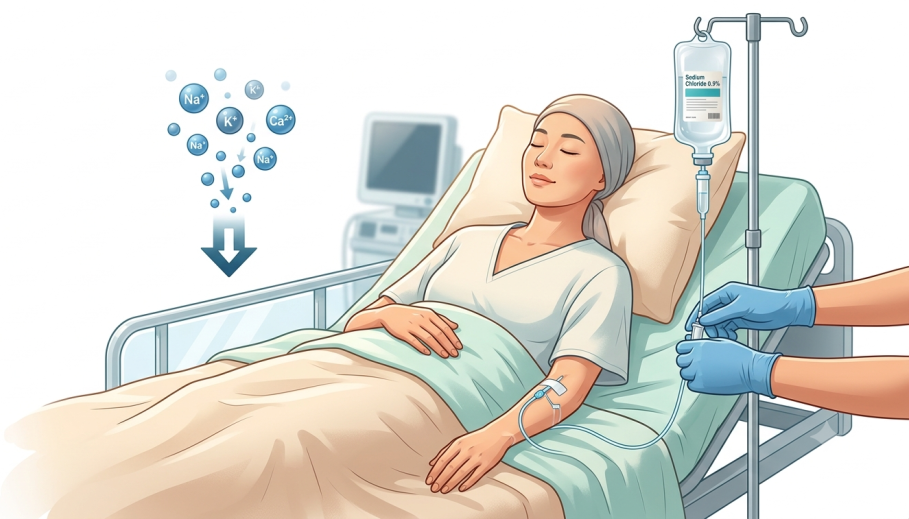
Why Cancer Patients Are Especially Vulnerable
For a healthy adult, a mild electrolyte dip is often self-limiting. For someone in active cancer treatment, the same imbalance can escalate much faster — and the causes are often layered on top of each other.
Chemotherapy side effects.
Severe nausea, vomiting, and diarrhea after treatment can strip the body of sodium and potassium within hours, faster than food or drink can replace them.
Appetite loss and cachexia.
Substances released by some tumors suppress appetite so completely that getting enough dietary minerals becomes nearly impossible, even before nausea is factored in.
The tumor itself.
Certain cancers disrupt hormone signaling directly. This is best documented in small cell lung cancer (SCLC), where tumor cells can produce antidiuretic hormone on their own, independent of the body's normal signals — a condition called SIADH (syndrome of inappropriate antidiuretic hormone secretion). Research shows SIADH-related hyponatremia shows up in roughly 10 to 16% of SCLC patients, compared with only about 2 to 4% of non-small cell lung cancer patients, and some studies estimate the rate even higher when broader diagnostic criteria are used. Cisplatin and certain immunotherapy drugs have also been reported to worsen hyponatremia in lung cancer patients, adding a treatment-related layer to a disease-related problem.
Because hyponatremia in SCLC often develops gradually, patients and even families can miss it — fatigue and mild confusion get chalked up to "the cancer" rather than recognized as a treatable electrolyte problem. Doctors sometimes catch the cancer diagnosis itself only after investigating unexplained low sodium, since a significant number of patients present with hyponatremia as their very first symptom.
Bone metastasis and calcium.
When cancer spreads to bone, calcium can leach out of the skeleton and flood the bloodstream, a condition called hypercalcemia of malignancy. It's more common than many people realize — it affects up to one in five cancer patients over the course of their disease, most often in multiple myeloma, leukemia, lymphoma, and solid tumors such as breast and kidney cancer. Early symptoms are easy to dismiss: malaise, confusion, excessive thirst, and constipation are the usual first signs, which is exactly why regular blood work matters during treatment. On the flip side, severe nutritional deficits can push calcium too low, causing painful muscle spasms known as tetany.
| Patient Situation | What Can Happen | Clinical Risk |
| Actively receiving chemotherapy | Low sodium/potassium from vomiting and diarrhea | Delayed or paused treatment cycles |
| Cancer with bone metastasis | Calcium swings — too high or too low | Confusion, severe bone pain, kidney strain |
| Small cell lung cancer | SIADH-driven low sodium | Neurological symptoms, seizures |
| ICU-level illness | Multiple electrolytes affected at once (multi-organ stress) | Elevated risk of shock and death |
How Electrolyte Testing Works
An electrolyte panel is one of the simplest blood tests there is, and it's often bundled into routine bloodwork during cancer treatment.
- Preparation. Fasting isn't required for an electrolyte panel on its own. If it's combined with a glucose or lipid panel, your provider may ask you to fast for about 8 hours beforehand.
- The blood draw. A standard sample is taken from a vein, usually in the inner elbow — the same process, and roughly the same discomfort, as any routine blood test. It takes one to two minutes.
- Lab analysis. The blood is spun in a centrifuge to separate the liquid serum, which is then run through an automated analyzer that reports each electrolyte's concentration.
Turnaround time depends on setting: outpatient results typically come back in one to three days, while emergency room or ICU labs can return results within an hour — sometimes in as little as 10 to 15 minutes when a patient's condition is urgent.
One quirk worth knowing: if a blood draw is rough — the tourniquet too tight, the syringe pulled too hard — red blood cells can rupture and release the potassium stored inside them. This is called hemolysis, and it can make a potassium reading look artificially high, sometimes requiring a repeat draw for an accurate result.
How to Correct an Electrolyte Imbalance Safely
The right fix depends entirely on how severe the imbalance is and which electrolyte is affected — there's no one-size-fits-all supplement.
For Mild Cases and Healthy Adults
- Food first. Potassium-rich foods like bananas, avocados, and tomatoes, plus magnesium-rich options like leafy greens and nuts, cover most day-to-day needs.
- Oral rehydration solution (ORS) for illness-related fluid loss. When diarrhea or vomiting causes real dehydration, plain water alone isn't enough — and can actually make things worse by diluting the sodium that's already low. ORS is built on a specific, medically balanced ratio of glucose and electrolytes designed for rapid absorption in the small intestine, a mechanism that works even when the gut is compromised by illness. Sports drinks aren't a substitute here: their higher sugar content and different electrolyte balance are built for athletic performance, and that extra sugar can worsen diarrhea rather than fix it.
For Cancer Patients and Anyone in Acute Care
- IV fluid correction, done slowly. Hospitals correct electrolytes gradually and under lab monitoring for good reason — swinging sodium levels back to normal too fast can trigger osmotic demyelination syndrome, a serious neurological injury, and correcting potassium too quickly can itself cause a fatal arrhythmia.
- Medical nutrition support. Patients who can't chew or eat normally may need electrolyte-balanced medical nutrition products rather than trying to catch up through regular meals.
- Targeted treatment of the underlying cause. For hypercalcemia of malignancy, standard care includes IV saline hydration along with bisphosphonate therapy to reduce bone breakdown. For SIADH-driven hyponatremia in SCLC, management typically combines fluid restriction, sodium supplementation, and sometimes a vasopressin-receptor blocker, alongside treating the cancer itself — since correcting sodium is often necessary before chemotherapy can even begin.
| Situation | Recommended Approach | Caution |
| After heavy sweating/exercise | Electrolyte drink, banana | Avoid drinks with excessive added sugar |
| Vomiting or diarrhea | Pharmacy oral rehydration solution, broth | Plain water alone can worsen low sodium |
| Cancer patients / acute illness | Blood-test-guided IV fluids in a medical setting | Never self-dose potassium or sodium supplements |

When to Seek Emergency Care
Go to an emergency room right away if you or someone you're caring for experiences:
- Confusion or a sudden drop in alertness
- Repeated vomiting
- Severe muscle cramping or spasms
- Difficulty breathing
- Fainting
- A racing or pounding heartbeat
- A seizure
The Bottom Line
Electrolyte imbalances are usually straightforward to diagnose with a blood test and, once the cause is identified, straightforward to treat. But "straightforward" doesn't mean "minor" — especially for anyone managing cancer treatment, where nausea, appetite loss, and in some cases the tumor itself can all pull sodium, potassium, or calcium out of a healthy range at the same time.
Rather than reaching for electrolyte supplements on your own, the safer path is a blood test to see what's actually happening, followed by guidance from your care team — since some imbalances point to an underlying issue, like kidney function or hormone signaling, that needs treatment in its own right. If you're caring for someone in active cancer treatment, keep in mind that sudden fatigue or confusion isn't always "just the cancer." It's worth a phone call and a blood draw to rule out an electrolyte problem that's very treatable once it's found.
This article is for general informational purposes only and is not a substitute for professional medical advice, diagnosis, or treatment. Always consult a qualified healthcare provider about any symptoms or before starting any supplement or treatment regimen.


