For decades, one line has traveled further than almost any other piece of nutrition advice: the French eat butter, cheese, and rich sauces, yet somehow avoid the heart disease rates seen in other wealthy nations — and red wine gets most of the credit. Researchers even gave the pattern a name, the French Paradox, and it turned a glass of Cabernet into something that sounded almost medicinal.
The idea still shows up in headlines every few years, usually stripped of nuance. So it's worth asking what the science actually supports going into 2026, rather than repeating a talking point from the 1990s.

Where the French Paradox Came From
The term entered popular use in the early 1990s after epidemiologists noticed something odd: France had comparatively low rates of coronary heart disease despite a diet loaded with saturated fat from cheese, butter, and charcuterie. That contradicted the prevailing nutrition science of the time, which treated saturated fat intake as the primary driver of heart disease risk.
Investigators looking for an explanation zeroed in on one obvious cultural difference — the French habit of drinking red wine with meals. Grapes fermented with their skins and seeds contain a range of plant compounds not found in the same concentrations in white wine, and that observation kicked off a long research trail into whether wine itself explained the gap.
The Case for Resveratrol — and Its Limits
Red wine owes its polyphenol content to the way it's made. Unlike white wine, which is typically pressed and fermented without the skins, red wine ferments with grape skins and seeds still in contact with the juice, pulling color and compounds into the finished product. That includes:
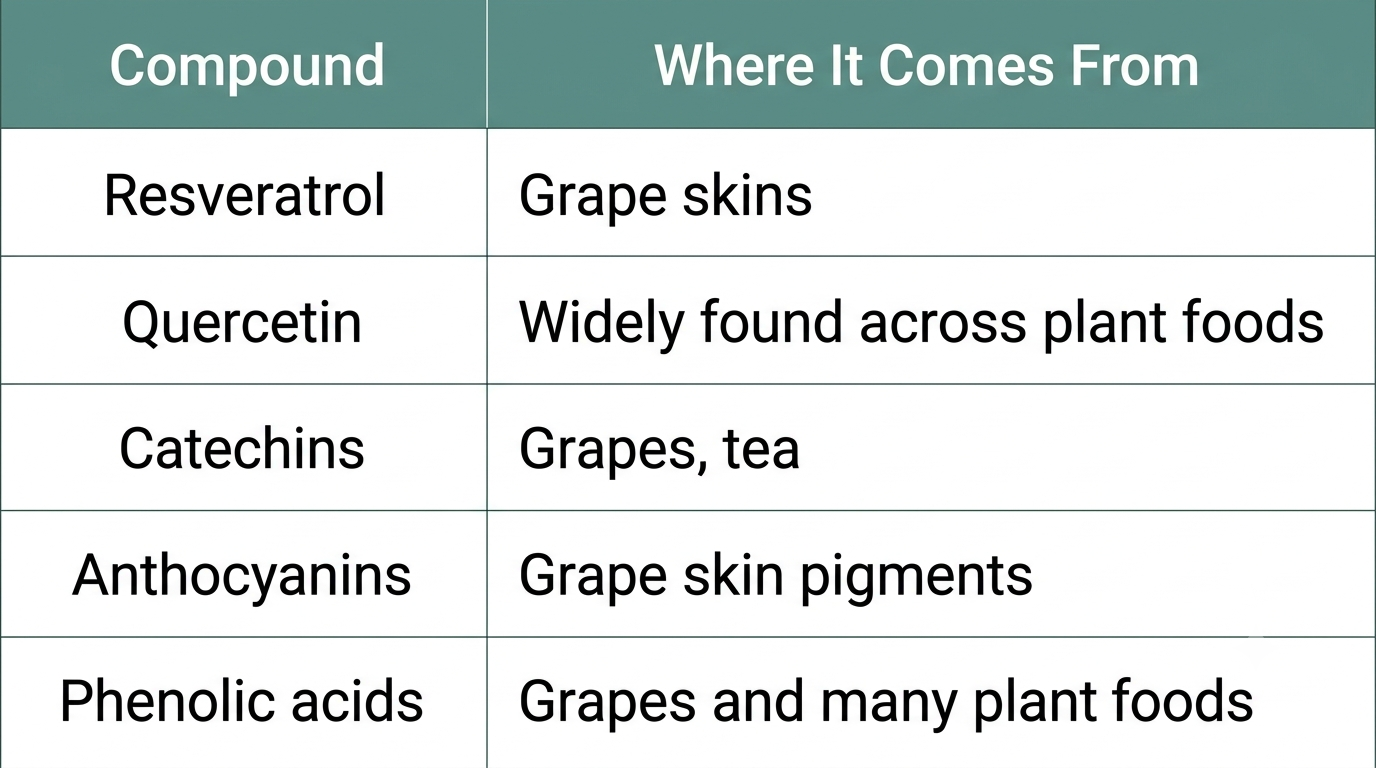
Resveratrol became the breakout star of this list. Laboratory research has linked it to reduced oxidative stress and improved function of the endothelium — the thin layer of cells lining blood vessels that helps regulate blood flow and vascular tone. A 2025 meta-analysis pooling animal and human studies found that red wine polyphenols were associated with modest reductions in systolic blood pressure, particularly in trials using purified resveratrol, though effects on diastolic pressure and arterial flow-mediated dilation were not statistically significant.
That's a real signal, but it's a narrower one than the supplement industry and wine marketing have sometimes implied. The doses used in cell and animal studies are often far higher than what a glass of wine delivers, and resveratrol is metabolized quickly once it reaches the human body. A compound behaving well in a petri dish is evidence worth investigating — not proof that drinking wine reproduces the same effect at a physiological scale.
What a 2025 Review of the Evidence Actually Found
A systematic review published in Annals of Medicine & Surgery in late 2025 screened more than 800 studies and included 36 that met its criteria for examining red wine's cardiovascular effects in people with coronary heart disease. The takeaway was cautiously positive: 28 of the 36 studies reported favorable changes in markers like lipid profiles, inflammatory markers, endothelial function, and gut microbiota composition, while two found adverse effects and six showed no meaningful association.
The review's authors framed this as support for the French Paradox hypothesis, attributing the benefit mainly to polyphenols rather than alcohol itself — a distinction supported by earlier work showing that de-alcoholized red wine can still produce measurable vascular effects. But the review also flagged what's been the field's persistent weakness: most of the underlying research is observational, the study populations vary widely, and few large randomized trials exist to settle the question definitively.

The Alcohol Complication
Here's where the picture gets more complicated than a single polyphenol can explain. In mid-2025, the American Heart Association released an updated scientific statement on alcohol and cardiovascular disease, and it was notably more cautious than the "a drink a day keeps the doctor away" framing that dominated public discussion in earlier decades.
The statement's conclusion: evidence suggests low-level drinking — roughly one to two standard drinks a day — carries no added risk to possible modest risk reduction for coronary artery disease, stroke, and sudden death, but the picture for atrial fibrillation remains unclear, and most of this evidence still comes from observational studies prone to confounding. Heavier drinking, by contrast, is consistently linked to worse outcomes across essentially every cardiovascular condition studied. The World Health Organization has gone further, stating that no level of alcohol consumption can be considered entirely risk-free.
None of this cancels out the polyphenol research. It does mean that any cardiovascular upside from wine has to be weighed against alcohol's own well-documented risks — something that gets lost when a headline reduces the French Paradox to "wine is good for you."
It Was Never Just About the Wine
The detail that tends to disappear from the popular version of the French Paradox is what else was on the table. Traditional French meals typically paired wine with vegetables, fish, olive oil, and nuts, eaten unhurried and treated as a social occasion rather than fuel. Research into Mediterranean-style eating patterns consistently points to the same conclusion: no single ingredient drives the cardiovascular benefit. It's the overall pattern — high in plant foods, moderate in animal protein, low in ultra-processed food — that correlates with better outcomes.
That reframes the practical question. It's less "does wine help my heart" and more "what does the rest of my plate look like when I'm drinking it."

A More Practical Way to Think About It
If you already enjoy wine, there's no compelling reason to be afraid of a glass with dinner, provided it fits within general moderate-drinking guidance — generally defined as up to one drink a day for women and up to two for men, though even that range now carries caveats per the 2025 AHA statement. If you don't drink, the current evidence doesn't offer a strong enough case to start for cardiovascular reasons alone.
A few practical anchors worth knowing:
Pour sizes vary more than people assume. A standard drink is about 5 ounces (roughly 150 mL) of wine at 12% alcohol by volume. Restaurant pours tend to hit that mark; a generous glass poured at home often doesn't.
Alcohol has calories, and sweet wines have more. Alcohol supplies about 7 calories per gram, and off-dry or dessert wines add residual sugar on top of that. If weight management matters to you, wine nights are the wrong time to also add dessert and late-night snacking.
Water alongside wine helps for a different reason than people think. It doesn't speed up alcohol metabolism, but alternating wine with water naturally slows the pace of drinking and supports hydration — a simple habit that does more than most people give it credit for.
You can get the polyphenols without the alcohol. Grapes, berries, and other deeply pigmented fruit contain many of the same compound families found in red wine. If resveratrol specifically interests you, whole grapes are a reasonable substitute worth having in the kitchen regardless.
Frequently Asked Questions
Is red wine healthier than white wine? Red wine generally contains more polyphenols because it's fermented with grape skins, while white wine typically isn't. That doesn't make white wine unhealthy — polyphenol content is just one variable among many, and it doesn't automatically translate into a measurable difference in health outcomes.
How much red wine is considered "moderate"? US dietary guidance has generally defined moderate drinking as up to one drink per day for women and up to two for men, with one drink equal to about 5 ounces of wine. The 2025 AHA statement reaffirms this as a reasonable ceiling while noting that even moderate intake isn't risk-free for every outcome.
Should I start drinking red wine for my heart? Current research doesn't support starting to drink for cardiovascular benefit alone. The polyphenol research is genuine but modest, and it has to be weighed against alcohol's documented risks — a trade-off that changes the calculation for someone who currently doesn't drink at all.

The Bottom Line
The French Paradox was never really a paradox about wine — it was a clue that pointed researchers toward a much larger pattern involving diet, lifestyle, and how people ate as much as what they drank. Red wine's polyphenols, resveratrol included, are genuinely interesting from a research standpoint, and the newest reviews keep finding modest, real signals in vascular and inflammatory markers. But the 2025 evidence, taken as a whole, supports treating wine as one small piece of a broader eating pattern rather than a supplement with cardiovascular guarantees.
If you like wine, enjoy it as part of a meal built around vegetables, fish, and whole foods, and keep the pour size honest. If you don't drink, skip it — the research doesn't ask you to start.
Sources referenced: Annals of Medicine & Surgery systematic review (2025); American Heart Association Scientific Statement on Alcohol Use and Cardiovascular Disease (Circulation, 2025); Nutrients/vascular health meta-analysis on red wine polyphenols; Mayo Clinic patient resource on red wine and resveratrol.


