Some people can down several drinks and barely change color. Others turn bright red after half a glass of wine. If you're in the second group, you've probably been told you just "can't hold your liquor." That explanation is mostly wrong — and understanding why matters more than you might think.
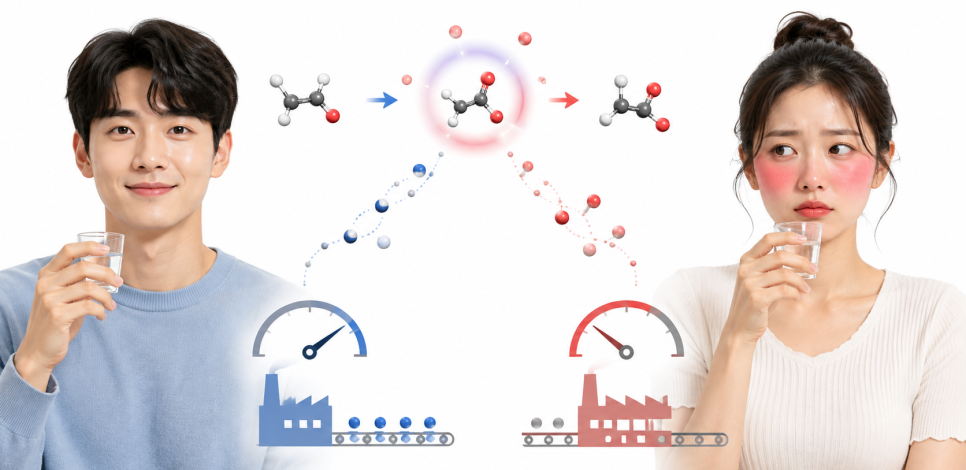
The redness has a name: alcohol flush reaction. It's not about willpower, tolerance built from practice, or how much you drink. It comes down to a single enzyme, and whether your body makes a working version of it.
What's Actually Happening in Your Body
When you drink, your liver doesn't turn alcohol into energy in one step. It's a two-stage breakdown:
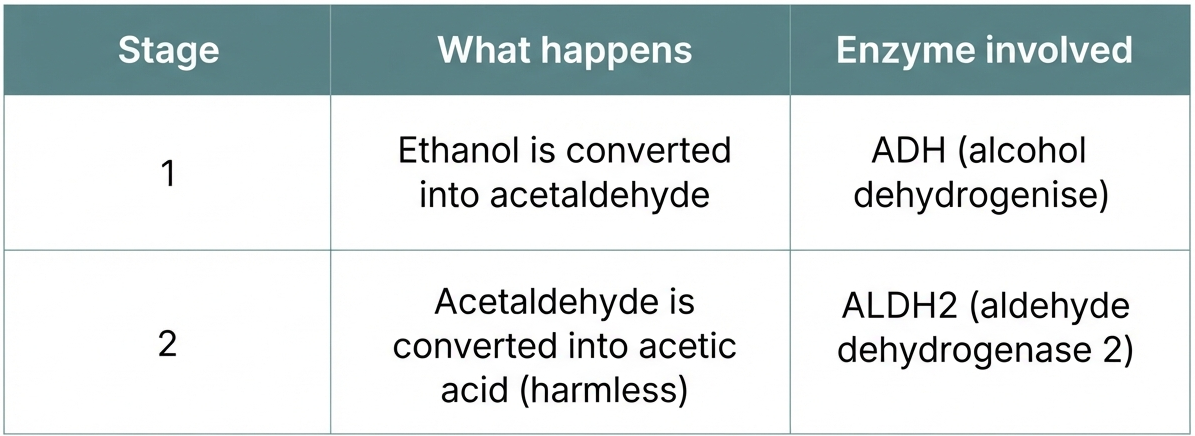
Acetaldehyde is the troublemaker in this chain. It's a toxic compound — one the International Agency for Research on Cancer classifies as a Group 1 carcinogen — and your body wants to clear it as fast as possible. ALDH2 is the enzyme that does that job.
The problem is that not everyone's ALDH2 works the same way. A common genetic variant, sometimes labeled ALDH2*2, produces an enzyme that's far less efficient at breaking acetaldehyde down. When that happens, acetaldehyde builds up in the bloodstream, and the body reacts: blood vessels near the skin's surface dilate, causing the flushed, reddened look, often paired with a racing heart, nausea, or a headache.
Why This Shows Up So Often in East Asian Populations
This isn't a random or rare trait. Research estimates that roughly 540 million people worldwide — about 8% of the global population — carry a reduced-function ALDH2 variant. But that number isn't spread evenly. Among people of Chinese, Japanese, and Korean descent, the rate climbs to somewhere between 30% and 40%, which is why the reaction is sometimes informally called "Asian glow" or "Asian flush" in English-language media.
That framing is a bit misleading, though. The flush reaction isn't exclusive to East Asian ancestry — it's just far more concentrated there because of how the ALDH2 gene variant spread through certain populations. Some people of Irish descent, for example, also experience alcohol-related flushing, though studies suggest that's more often linked to differences in a related enzyme, ALDH1, rather than ALDH2. Different mechanism, similar-looking result.
"Lightweight" and "Genetically Intolerant" Are Not the Same Thing
It's worth separating two ideas that tend to get mixed together:
- Alcohol tolerance is a behavioral, day-to-day measure — how many drinks someone can have before feeling the effects.
- Alcohol metabolism is a biological process — how efficiently your body actually clears ethanol and its byproducts.
Someone whose face never turns red can still be significantly affected by alcohol; a calm complexion doesn't mean fast metabolism. On the flip side, a person who flushes after one drink isn't necessarily "weak" — their body is sending a clear signal that acetaldehyde is accumulating faster than it can be cleared.
There's also a counterintuitive twist: some people with a partial ALDH2 deficiency (carrying just one copy of the variant) develop a tolerance to the visible flushing the more regularly they drink, even though their underlying enzyme function hasn't improved. Studies from Japan and Taiwan have tracked rising rates of heavy drinking among this group — from roughly 2–3% decades ago to somewhere in the 17-26% range more recently. The flush fading with repeated exposure doesn't mean the acetaldehyde exposure is any safer. If anything, it removes the one warning sign the body was giving.
Why the Reaction Isn't Always the Same, Even for the Same Person
If you've ever noticed that you flush more on some nights than others, that's not your imagination or a sign that your "constitution" suddenly changed. Several factors stack on top of your baseline genetics:
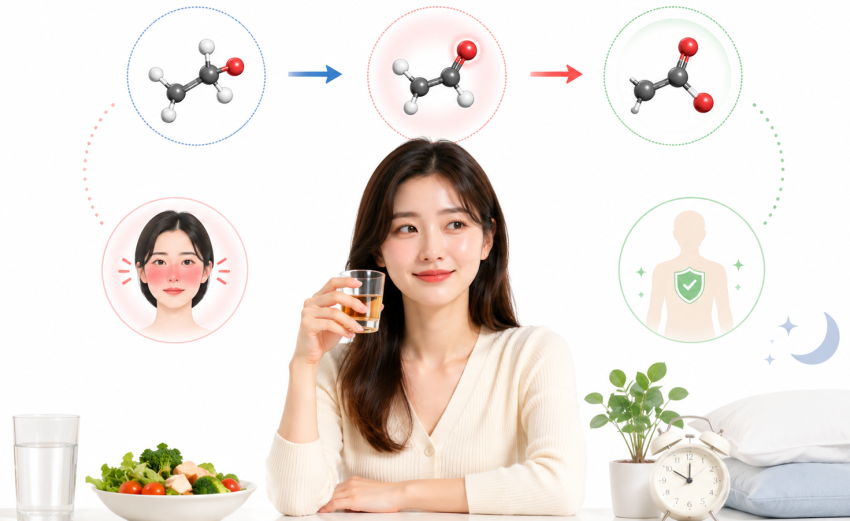
- How much and how fast you drink — a slower pace gives your liver more time to process each dose.
- Whether you've eaten — drinking on an empty stomach speeds up alcohol absorption.
- Sleep and general health that day — being run-down can lower your tolerance for the same amount of alcohol.
- Medications — some common drugs interact with alcohol metabolism and intensify flushing.
If the flushing is sudden, unusually severe compared to your normal pattern, or comes with hives, difficulty breathing, or fainting, that's no longer a routine "flush" — it's worth medical attention rather than something to wait out.
Does Taking an Antihistamine Beforehand Fix the Problem?
This is a popular workaround, and it's worth addressing directly because it's genuinely risky advice. Taking an antihistamine before drinking can suppress the visible redness — but it does nothing to help your body clear acetaldehyde faster. The toxic compound is still accumulating in your tissues; you've just masked the warning light on the dashboard.
The U.S. National Institute on Alcohol Abuse and Alcoholism (NIAAA) has specifically noted that flush-suppressing medications don't prevent acetaldehyde-related damage, and that reduced redness should never be read as a green light to drink more.
The Longer-Term Risk Worth Knowing About
A single flushed evening isn't dangerous on its own. The concern is what repeated exposure means over years, specifically for people with reduced ALDH2 function.
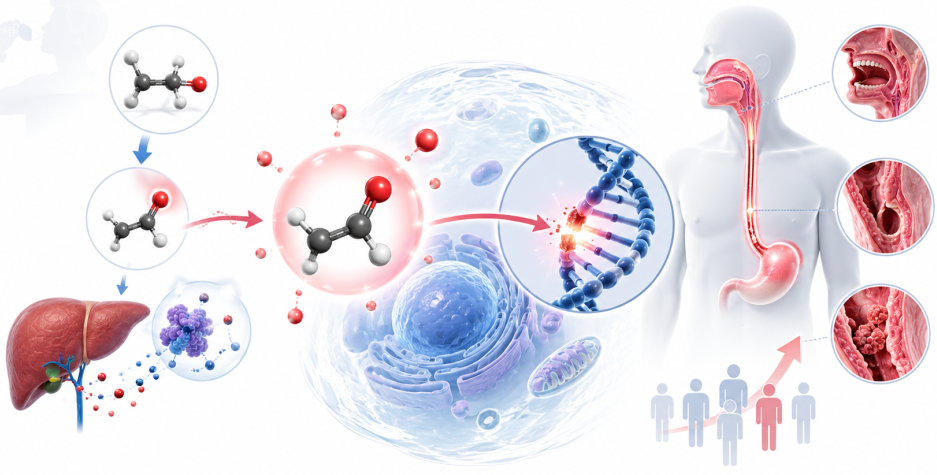
The U.S. National Cancer Institute has linked chronic acetaldehyde exposure to DNA and protein damage, and notes that people with the ALDH2 variant who continue to drink regularly face an elevated risk of esophageal and other head-and-neck cancers. NIAAA echoes this, pointing to increased risk in the upper digestive and respiratory tract for people with this genetic profile who drink alcohol.
The risk compounds sharply for people who also smoke. Several studies have found that combining alcohol and tobacco use raises the risk of oral, throat, and esophageal cancers by more than simply adding the two risks together — the combination appears to be synergistic rather than additive.
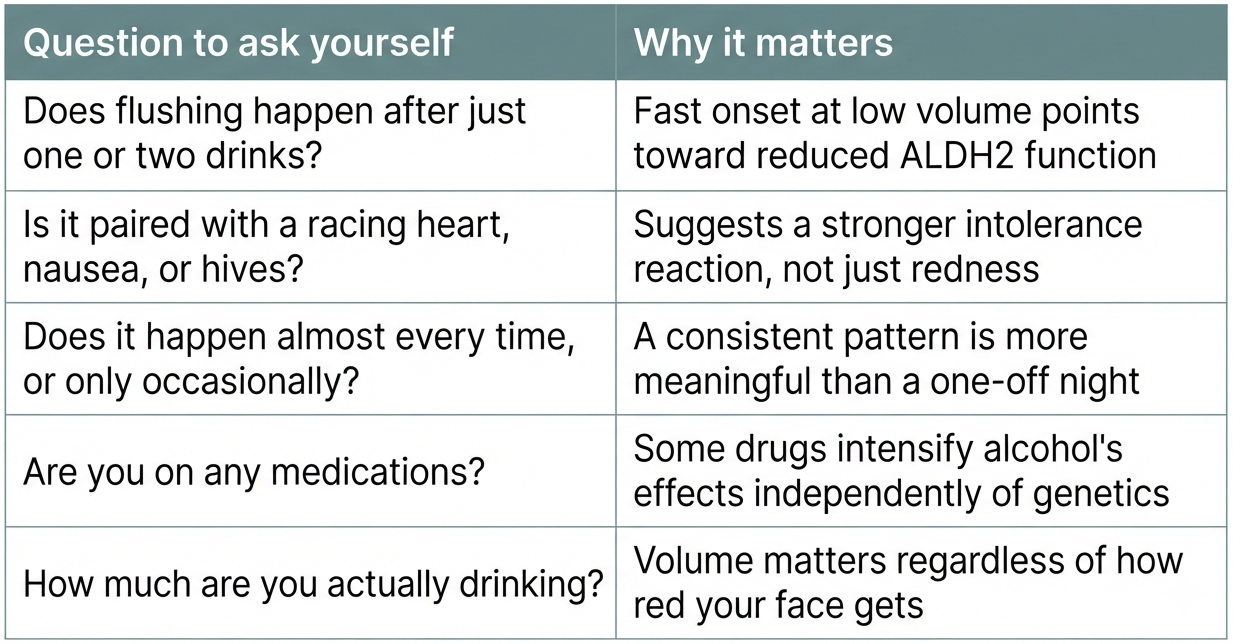
A Quick Checklist Before You Shrug It Off
The Bottom Line
Turning red after a drink isn't a character flaw, and it isn't proof of a weak tolerance either. It's usually a visible marker of how efficiently — or inefficiently — your body processes acetaldehyde, largely determined by the ALDH2 gene you inherited.
If this sounds like you, the more useful question isn't "how do I stop turning red," but "what is my body telling me about how it handles alcohol." For a meaningful share of people, especially those of East Asian descent, that signal is worth taking seriously — not suppressing with an antihistamine and pushing through.
This article is intended for general health information and does not diagnose any individual's genetic profile or medical condition. If you experience severe or unusual reactions after drinking — including difficulty breathing or fainting — consult a healthcare provider.
Sources referenced: U.S. National Institute on Alcohol Abuse and Alcoholism (NIAAA), U.S. National Cancer Institute (NCI).


