Almost everyone has seen it happen: a coworker who barely says a word at the office turns into the life of the party after a few drinks, suddenly chatting away with people they'd normally exchange two sentences with.
It gets more interesting — and more confusing — when the conversation turns personal. A confession, an old grudge, a "the truth is, I've liked you for a while" moment. The question that usually follows is whether any of it was real, or just something the alcohol talked them into saying.

What Alcohol Actually Does to Your Filter
Under normal circumstances, people don't say everything that crosses their mind. There's a quick, mostly automatic filtering step — how will this land? is this the right moment? — that happens before words leave your mouth.
That filtering relies on brain functions responsible for impulse control and situational judgment. Alcohol interferes with those functions. Research on acute alcohol intoxication has repeatedly shown reduced response inhibition, which is the technical term for that same filtering process. In plain terms: the mental brake that normally stops you from blurting something out gets weaker.
This is the key point that gets lost in most explanations of "drunk honesty": alcohol doesn't manufacture new thoughts or feelings that weren't there before. It lowers the threshold for expressing ones that already existed.
Sober vs. Drunk: What Actually Changes
The clearest shift isn't in what people feel — it's in how strongly they express it.
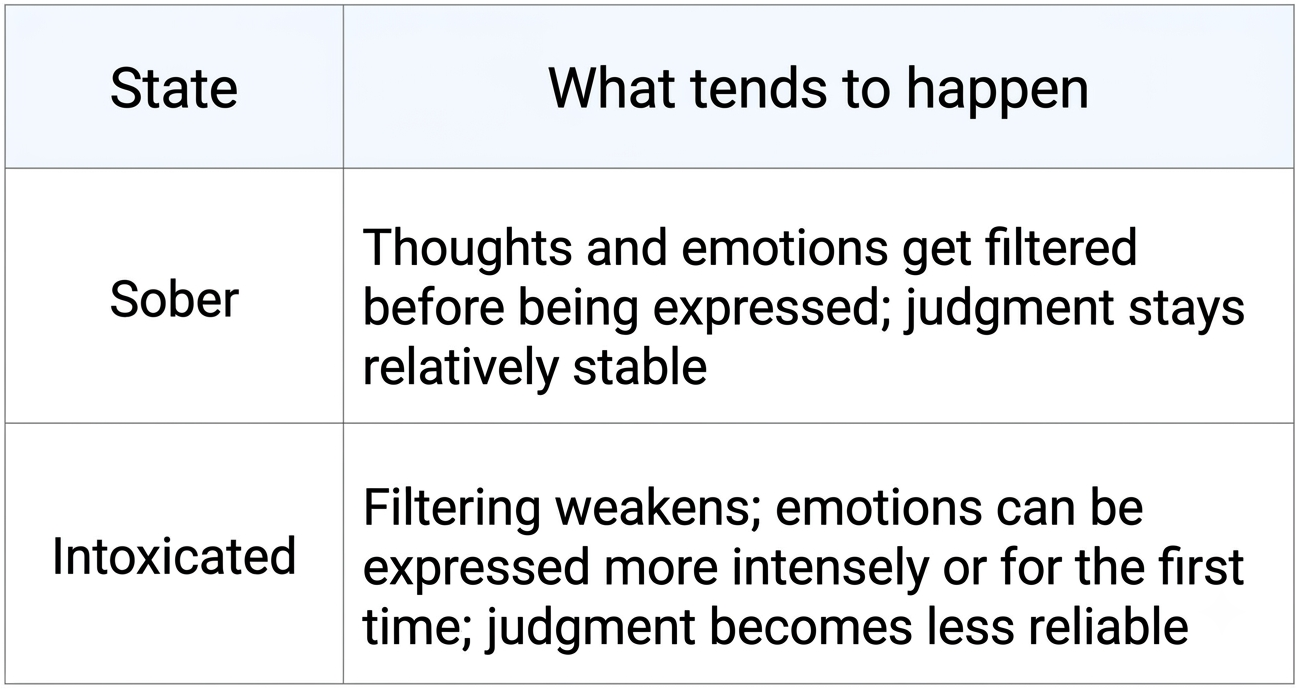
A minor annoyance from earlier in the week can come out sounding like a long-standing grievance. A crush someone's been too embarrassed to mention might surface for the first time. The feeling itself isn't new — the volume and timing are what change.
Why Secrets Slip Out, Too
People manage their thoughts and feelings carefully as part of everyday social life. Even with someone you trust completely, personal secrets usually stay put.
Alcohol changes the equation in two ways at once. It temporarily lowers tension and creates a sense of closeness with whoever you're talking to — and at the same time, it weakens the self-control that normally keeps certain things unsaid. Put those together, and something you'd usually stop yourself from saying has a much easier path out.
That said, sharing a secret while drunk doesn't automatically mean someone is being more honest than usual. Judgment is less reliable in that state, and memory of the conversation may not be fully accurate afterward either.
Why Everyone's Drinking Personality Is Different
Give the same amount of alcohol to five different people and you'll likely get five different reactions — one gets talkative, one goes quiet, one laughs at everything, one gets weepy. That variation comes from a mix of personality, mood going into the night, the social setting, and how much and how fast someone drank. No single factor explains it on its own.
That's also why the claim that "alcohol reveals someone's true, hidden self" deserves some skepticism. Alcohol doesn't turn someone into a different person — it weakens the mechanisms that normally regulate emotion and behavior, which makes impulsive or emotional reactions more likely to surface.

How to Tell If a Drunken Confession Was Real
If something said during a night of drinking is still on your mind, resist the urge to decide what it meant right away. Instead, check for these three things over time:
- Has this person shown similar feelings or thoughts when sober, even in smaller ways?
- Do they say the same thing again once they've sobered up?
- Does their everyday behavior actually line up with what was said?
If all three line up, it's reasonable to take the statement more seriously as a genuine feeling rather than something alcohol invented. If none of them do, it's more likely you witnessed a moment of amplified emotion that doesn't reflect a consistent pattern.
So is "drunk honesty" a myth or a fact? Neither, exactly. It's usually a mix of feelings someone genuinely had but hadn't voiced, blended with emotional exaggeration that alcohol makes easier to express. If something said really matters to you, the most reliable move is to bring it up again once the alcohol has fully worn off.
This article is based on general health and lifestyle information and is not a substitute for professional advice. If you or someone you know experiences repeated memory blackouts, uncharacteristic aggression, severe mood changes, or difficulty controlling alcohol use, consult a medical professional or an appropriate support service.


