Hearing the words "you'll need a port placed" for the first time is unsettling, especially when it's a parent or family member going through treatment rather than yourself. The idea of a device sitting under the skin, connected to a major vein, can sound more alarming than it actually is.
When my own mother needed one during her hospital treatment, I remember feeling exactly that kind of unease. Once I understood what the device was actually doing, though, it became a lot less intimidating. A chemoport isn't an extra complication bolted onto treatment — it's a tool designed to make repeated vein access safer and less painful over the course of long-term care.
This guide walks through what a chemoport is, why it's used, how it compares to a PICC line, and what to watch for once it's in place.

What Exactly Is a Chemoport?
The medical term is a totally implantable venous access port, sometimes shortened to "port" or "chemoport" (the name comes from its common use in chemotherapy, though it's used for other long-term IV treatments too).
In plain terms, it's a small reservoir placed just under the skin, connected to a thin tube that runs into one of the body's larger veins. It has two parts:
- The port — a small disc, usually about the size of a large coin, sitting under the skin. It has a self-sealing silicone center that a needle can pass through repeatedly.
- The catheter — a thin, flexible tube connecting the port to a central vein.
Because the entire device sits beneath the skin, there's no tubing sticking out of the body day to day. You might notice a slight bump where it's placed, but that's usually the only visible sign. Think of it less as a permanent tube and more as a hidden access point that only gets "opened" when treatment is actually happening.
Why Do Patients Need One?
The short answer: to reduce the wear and tear of repeated IV access.
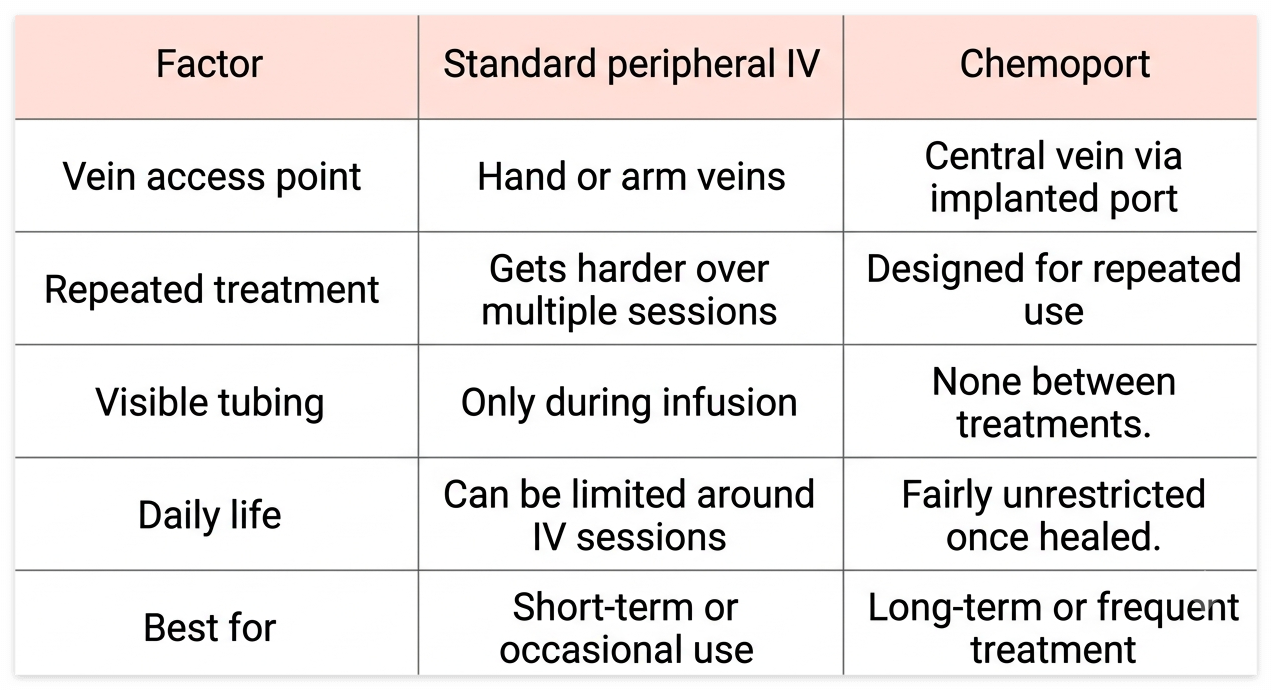
A standard IV uses small veins in the hand or arm. That works fine for a one-off treatment, but repeated sessions over weeks or months are a different story. Veins can become irritated, scarred, or simply hard to find after enough punctures.
There's also a safety angle. Certain medications, including many chemotherapy drugs, can damage surrounding tissue if they leak outside the vein. Getting reliable access to a larger, more stable vein matters for more than just convenience — it reduces that risk.
That said, a port doesn't eliminate every vein-related concern. Infection, blood clots, blockages, and catheter issues can still occur even with a port in place. The more accurate way to think about it: a port gives you one stable, reusable pathway for treatment — not a guarantee against every complication.
Chemoport vs. Standard IV: A Quick Comparison
How Is a Chemoport Accessed During Treatment?
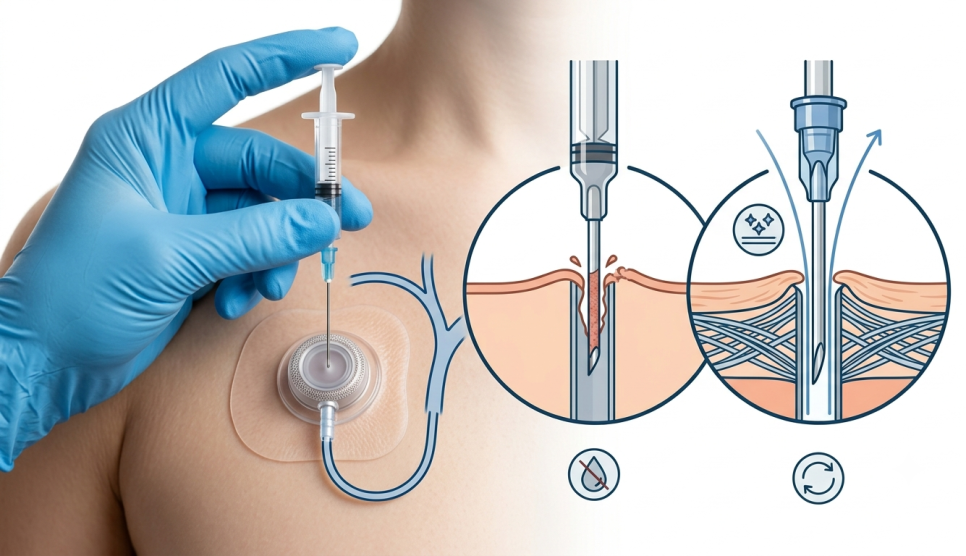
Nurses use a specific type of needle called a Huber needle (a non-coring needle), not a standard IV needle. Its design lets it pass through the port's silicone membrane repeatedly without damaging it over time.
The process is straightforward: the skin is cleaned, the port's position is confirmed, and the needle is inserted through the skin into the center of the port. Numbing cream is sometimes used beforehand to reduce discomfort.
Here's a detail worth knowing if you or a family member has a port: sharp pain during needle insertion, or unusual burning, swelling, or discomfort during an infusion, is not something to just tolerate. It's easy to assume that because the device is internal, problems would be obvious to medical staff — but the patient's own sensation is often the first and most useful signal that something needs checking.
Chemoport or PICC Line — Which One Is Used, and Why?
Both are types of central venous access, but they work differently day to day.
A PICC line (peripherally inserted central catheter) is a long tube inserted through a vein in the arm, with its tip resting in a central vein near the heart. A chemoport instead implants the reservoir itself under the skin.
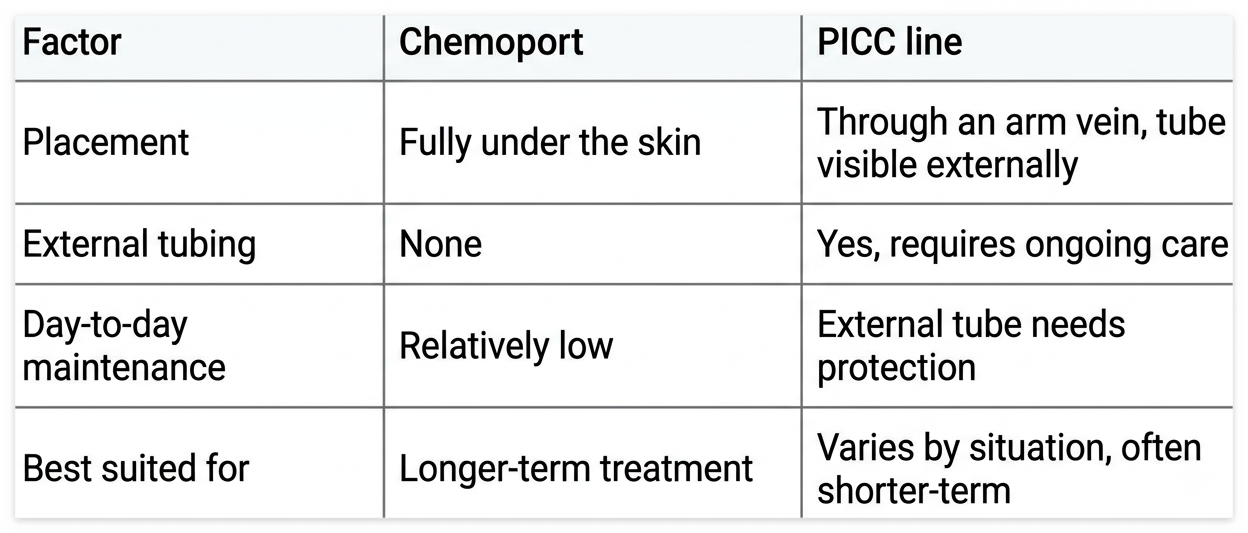
Neither option is universally "better." The choice usually comes down to expected treatment length, vein condition, and how a patient wants to manage daily life during treatment — something decided together with the care team rather than a fixed rule.
What to Watch For Right After Placement
In the first days after implantation, the surgical site — not the port itself — needs the most attention. Some soreness or bruising around the incision is normal, and the care team will usually give specific instructions about dressing changes, showering, and activity limits during recovery. Stitches may need to be removed after a set period if they aren't the dissolvable type.
It's also worth avoiding the habit of pressing on or repeatedly checking the port site. Beyond just being unnecessary, excessive handling can contribute to the port shifting out of its original position over time.
Warning Signs That Need Immediate Attention
A chemoport is meant to make treatment easier, but catching problems early matters just as much as the device itself. Contact the care team if any of the following occur:
- Redness, warmth, or significant pain around the port site
- Discharge or pus at the insertion site
- Sudden swelling near the port
- The port feels like it has shifted position or moved more than usual
- Swelling in the arm, neck, or face on the side where the port is placed
- Unusual pain or burning during an infusion
- Fever or chills that could suggest infection
If something feels off during an infusion — more pain or burning than usual — it's better to flag it than to assume it's a normal part of treatment. It could point to a blockage or positioning issue that needs a quick check.
What Happens to the Port When Treatment Ends?
A chemoport isn't a permanent fixture. Once a patient no longer needs regular vein access, the port and catheter can be removed, usually under local anesthesia, with a small incision closed afterward.
The timing of removal isn't left entirely up to the patient, though — the care team factors in whether future treatment or testing might require vein access again before deciding it's the right time to take it out.

The Bigger Picture
The idea of "something implanted in the body" makes a chemoport sound more intimidating than it usually turns out to be in practice. A more useful way to think about it: it's a dedicated access point built to make frequent treatment less painful and more manageable, not an extra burden layered on top of an already difficult process.
It does come with real risks — infection, clotting, and blockage are all possible — so it's not a maintenance-free device. But understanding the warning signs and following your care team's guidance goes a long way toward keeping it a helpful part of treatment rather than a source of added worry.
Watching my mother go through this during her own treatment made the whole idea feel a lot less abstract. Once I understood what the port was actually doing for her, it stopped feeling like "one more medical device" and started making sense as one stable, reusable pathway through a long treatment process.
Three things worth remembering:
- A chemoport is a fully implanted central venous access device.
- Its main purpose is providing stable, repeatable vein access for ongoing treatment.
- Care routines and flushing schedules vary by patient, so the care team's specific instructions always take priority over general guidance.
And above all: unusual swelling, fever, or pain during use should never be brushed off as "probably nothing." Flagging it early is almost always the safer call.
This article is intended as general health information about chemoports. Actual placement procedures, usage timing, flushing schedules, and removal timing vary depending on the individual patient, the type of port used, and the practices of the treating institution. Always follow the specific guidance given by your care team.


