You've probably heard the advice: don't lie down right after a meal. But is there an actual number of hours behind it, or is that just something people repeat without knowing why?
The short answer is that it depends on whether you experience acid reflux. If you get heartburn or regurgitation, especially at night, waiting 2 to 3 hours before lying down is genuinely worth doing. If you don't have those symptoms, the "3-hour rule" isn't something you need to track down to the minute.
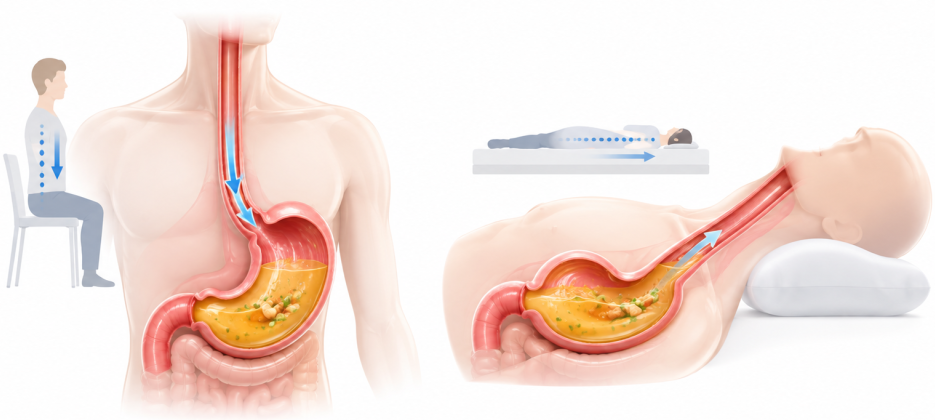
Why Lying Down Right After Eating Causes Problems
When you eat, food sits in your stomach while digestion gets underway. While you're upright, gravity keeps stomach contents where they belong. The moment you lie flat, that gravitational assist disappears, and stomach acid has an easier path back up into the esophagus.
If you've ever eaten a heavy, greasy meal and gone straight to bed, you may already know what this feels like — a burning sensation in the chest or a sour taste creeping up your throat. That's classic acid reflux, and lying down is often the trigger that makes it noticeable.
Where the "3-Hour Rule" Actually Comes From
This isn't just folk wisdom. The National Institute of Diabetes and Digestive and Kidney Diseases (NIDDK) recommends finishing meals at least 3 hours before bedtime for people who experience reflux symptoms at night or while lying down. The American College of Gastroenterology (ACG) echoed this in its 2022 clinical guideline, listing avoidance of meals within 2 to 3 hours of bedtime as one of the core lifestyle measures for managing gastroesophageal reflux disease (GERD).
Here's the part that often gets lost: both of these recommendations were written specifically for people with reflux symptoms — not as a universal rule for everyone. If you never experience heartburn or acid regurgitation after eating, there's no medical reason to panic over falling short of exactly 180 minutes. This is a symptom-management strategy, not a fixed biological cutoff.
What About Napping After a Meal?
A common point of confusion: does the same rule apply to daytime naps, or only nighttime sleep? Since your body doesn't distinguish between a 2 p.m. nap and an 11 p.m. bedtime — the stomach and esophagus are in the same position either way — the same logic applies. If you regularly deal with post-meal heartburn, an after-lunch nap flat on your back carries the same risk as lying down after dinner.
If you're just tired and want to rest for a few minutes, reclining in a chair or propping yourself up with pillows is a reasonable middle ground. You get to rest without putting your stomach in a position that invites reflux.
A More Useful Way to Think About Timing
Say your bedtime is 11 p.m. and you finished dinner at 9. Rather than stressing over whether you've hit the full 3-hour mark, it's often more practical to simply shift dinner earlier. Chasing an exact number of minutes tends to create more anxiety than it solves.
The better question to ask yourself isn't "how many hours has it been?" but "do I actually get symptoms when I lie down?" Reflux tolerance varies quite a bit from person to person — portion size, the specific food eaten, body weight, and baseline digestive health all play a role. Someone can eat the exact same dinner and have a completely different experience than someone else.
So instead of counting minutes, pay attention to the pattern: does lying down shortly after a late dinner reliably trigger discomfort? If it doesn't, you likely don't need to enforce a strict waiting period. If it does, building in that buffer before bed is a genuinely useful habit — not an overreaction.
A note on when to see a doctor: This article is for general information and isn't a substitute for medical advice. If you experience recurring heartburn, acid regurgitation, or chest discomfort after eating — especially if lifestyle changes don't help — it's worth talking to a healthcare provider. Sudden or severe chest pain should never be dismissed as simple indigestion; seek medical attention promptly.


