You trim your nails every two weeks like clockwork. Then one month they feel too long after ten days, and the next month they barely seem to have moved. Did your nails speed up and slow down, or is something else going on?
Usually it's something else. This guide covers how fast fingernails actually grow, why they can look faster or slower than they are, how age, season, and diet fit in, and which changes are worth showing a doctor.
How fast do fingernails grow?
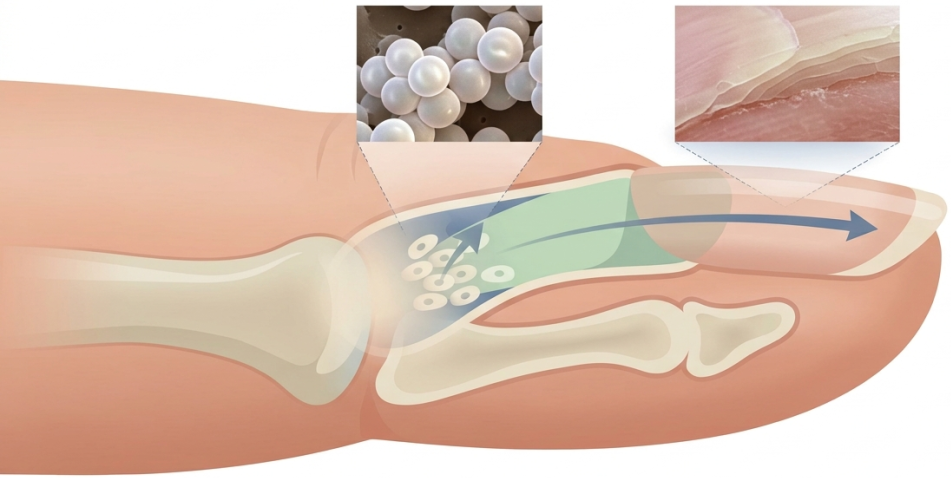
Nails grow from the nail matrix, a small area of cells under the skin at the base of the nail. New cells form there, harden, and push the nail plate forward. The American Academy of Dermatology (AAD) puts average fingernail growth at about 0.1 mm per day, or roughly 3 mm per month. A study of healthy adults found an average close to 3.5 mm per month.
At that pace, a fingernail takes about six months to grow out fully. Toenails are slower, at roughly a millimeter a month, and can take a year or more to replace themselves.
Those numbers are averages. Growth differs from person to person and finger to finger. The little finger is reported to grow more slowly than others, and some studies suggest the dominant hand grows a bit faster. Two fingers on the same hand can move at different speeds.
Why growth can look uneven
Real growth speed is only part of the story. What you see also depends on how the nail is trimmed, worn, and damaged.
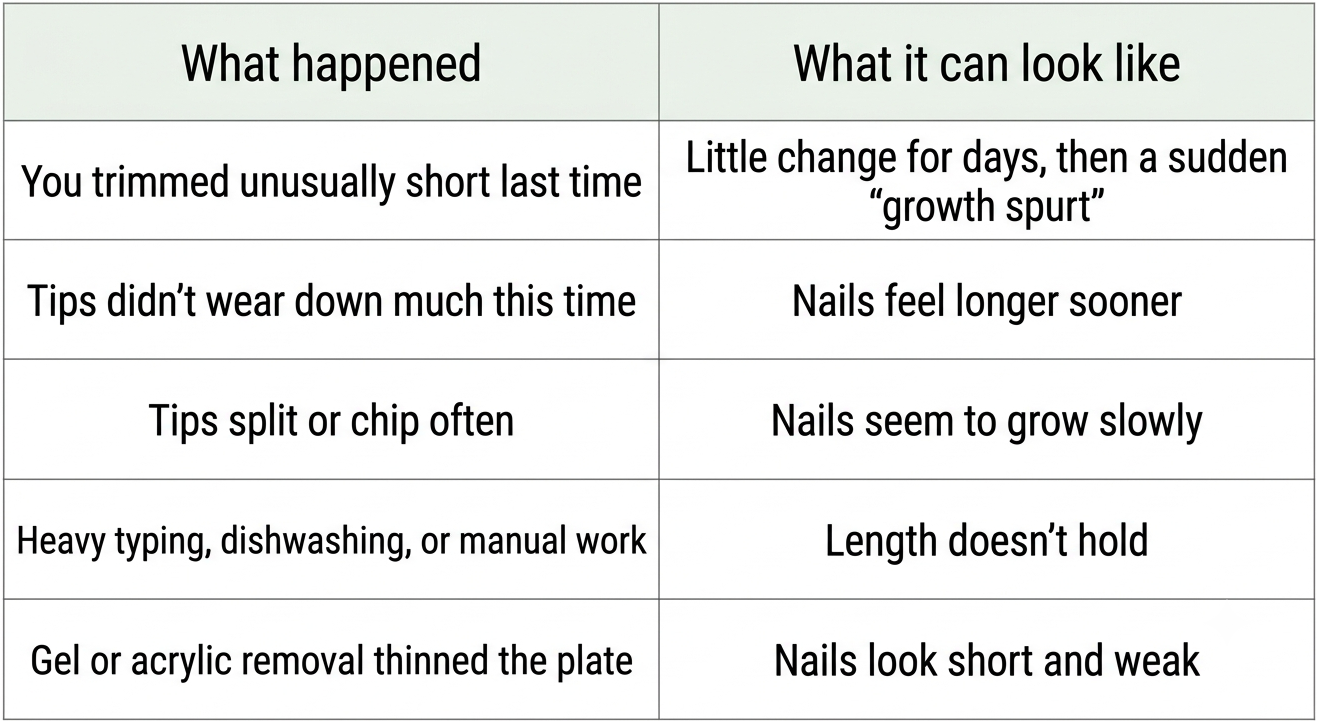
So a nail that feels "slow" may be growing at its usual rate but breaking off as fast as it grows. And a nail that seems to have sped up may just have started from a shorter trim.
How to measure your own growth
If you want a real answer, measure it.
- Put a small dot or thin line of nail polish or marker near the base of the nail, right at the edge of the cuticle.
- After two weeks, measure the distance from the cuticle to the mark.
- Repeat a few times on the same finger.
Once you know your own baseline, a real change becomes much easier to spot.
Does age or season matter?
Growth tends to slow gradually with age, though the pace varies too much to name a specific age when it starts. If you've been trimming a bit less often over the years, that can be a normal shift.
The seasonal story is less clear. People often say nails grow faster in summer, but at least one study of human nails found no clear seasonal difference. Seasons do change other things: nail moisture content has measured lower in winter in some research, and habits like hand washing, exposure to water, and activity shift through the year. If your nails behave differently in different months, those factors may matter more than temperature alone.
Do diet and stress change nail growth?
Nails are living-tissue products, so overall health matters. Long stretches of poor nutrition can affect nail quality.
That said, slow growth alone is a weak clue for a specific deficiency. Look for other signs, such as thin, brittle, or splitting nails. The AAD advises healthy adults to get nutrients from a balanced diet and to consider supplements only when a deficiency is confirmed by a doctor. One practical note: high-dose biotin, a popular "nail" supplement, can interfere with some lab tests, so tell your doctor if you take it.
Before buying supplements, check the basics: recent meals, sleep, weight changes, and how tired you've been.
When a nail change deserves a closer look
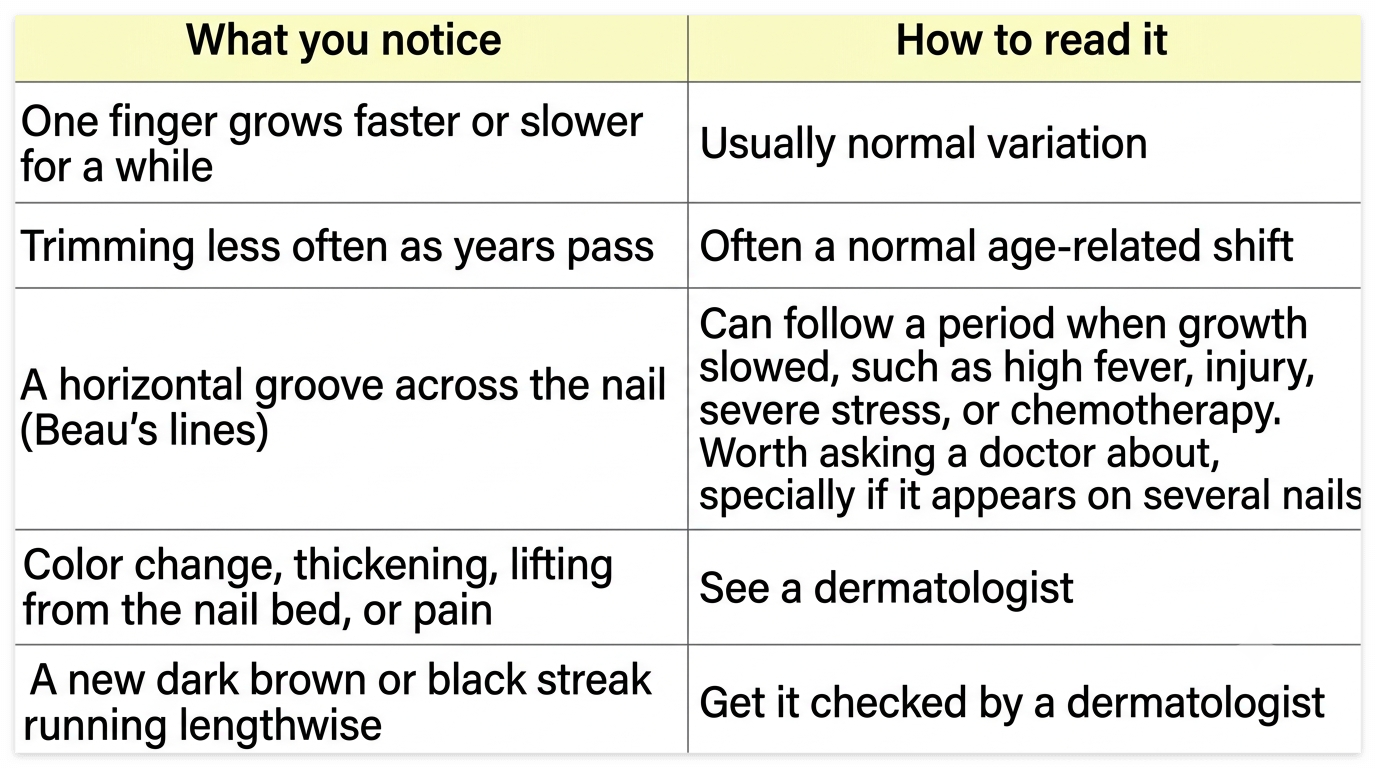
A Beau's line works like a growth record. The groove marks a period when the matrix slowed down or paused, and it moves forward as the nail grows. The cause can vary, so avoid guessing on your own.
The takeaway
Nails don't grow at a perfectly steady pace, and what you see reflects trimming habits, wear, and breakage as much as growth. If you want certainty, mark the nail and measure it. Pay attention when a change lasts a long time or comes with a shape, color, or comfort change. In those cases, a dermatologist can look at the actual nail.
This article is for general education and isn't medical advice. It can't diagnose any condition. If nail changes persist, or come with pain, discoloration, thickening, lifting, or deep grooves, talk with a healthcare professional.


