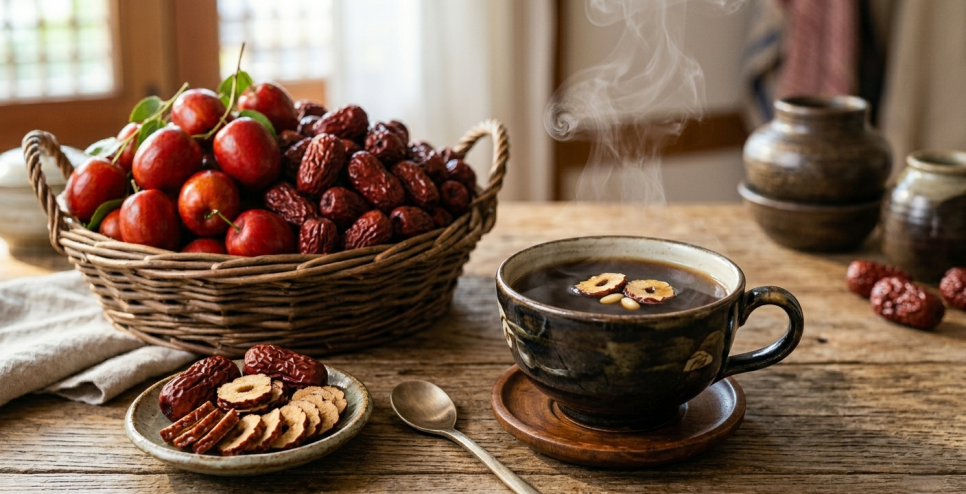
Jujube (Ziziphus jujuba) goes by many names. English-language sources call it red date or Chinese date, Korean cooks call it daechu, and Chinese herbal texts call it hong zao. People drink it as tea, simmer it into soups, and snack on it dried.
Online, it also collects a lot of big health claims. Some have research behind them, some rest on traditional use, and some are mostly marketing. This guide separates those three groups and covers how to eat jujube safely.

What’s in a jujube
Per 100 g, USDA data for raw jujube lists about 79 calories, 69 mg of vitamin C, and 250 mg of potassium. Vitamin C is the standout. The Korean food-safety ministry’s nutrient data, as cited in Korean press, puts raw jujube at about 86 mg per 100 g, so the exact figure varies by cultivar and source.
Drying changes the picture:
- Vitamin C drops sharply. USDA’s reference entry for dried jujube lists about 13 mg per 100 g, and a Korean study measured roughly 15 to 17 mg. A few commercial databases list much higher numbers for dried fruit, but I would not count on dried jujube as a vitamin C source.
- Sugar and calories concentrate. Dried jujube comes in at roughly 280 kcal per 100 g, about 3.5 times the fresh fruit, because the water is gone.
If you want the vitamin C, eat fresh. If you want a naturally sweet dried fruit, treat dried jujube like raisins or dates.
Jujube tea: what to expect
Jujube tea tastes mildly sweet, a bit like a faint apple-date infusion. It is warm and caffeine-free, which makes it a reasonable evening drink. Beyond that, what it does for your body is less clear than most blog posts suggest.
Sleep and stress. Jujube has a long history in East Asian herbal medicine as a calming food. Researchers have studied its extracts for sleep and anxiety, but the work is early, and most studies use concentrated preparations rather than a mug of tea. A cup before bed is unlikely to hurt, but don’t expect it to treat insomnia. If poor sleep lasts more than a few weeks, see a clinician.
The seed question. Many recipes tell you to crush the seeds into the tea for better sleep. That advice mixes up two things. The herbal medicine suan zao ren comes from the seeds of sour jujube (Z. jujuba var. spinosa), and it is a different material from the pit of an ordinary jujube. Nothing I could verify shows that ordinary jujube pits work the same way. Remove the pit before eating the fruit, and skip crushing it into drinks.
Immunity, skin, digestion. Fresh jujube supplies vitamin C and some potassium, and fruit generally contributes to a healthy diet. Claims that jujube “boosts immunity,” “detoxes the liver,” or “reverses skin aging” go well beyond what the evidence supports.
The cancer claims, in context
Jujube contains compounds such as betulinic acid, other triterpenoids, polysaccharides, and polyphenols. In cell and animal experiments, some of them have affected cancer cells or immune cells. That finding is real, and it is also where the evidence stops.
Those experiments use isolated or concentrated compounds, usually in lab dishes or animals. No human trial shows that eating jujube or drinking jujube tea prevents or treats cancer. Phrases like “kills cancer cells selectively” describe lab results, not what happens in a person.
If you are in cancer treatment, check with your oncology team before adding herbal products or large amounts of any supplement.
Who should be careful
- People managing blood sugar. Dried jujube is concentrated sugar, and there is no universal “safe number of pieces.” A dietitian or doctor can help you fit it into your plan.
- People taking medication, especially sedatives or other sleep and anxiety drugs. Herbal products can interact with medicines, so ask a pharmacist before making jujube tea a daily habit.
- Anyone with a sensitive stomach. Some people get gas or loose stools from large amounts of dried fruit. If that happens, cut back.
- People with sulfite sensitivity or asthma. Some dried fruit is treated with sulfites. Check the label.
- Everyone, for teeth. Dried jujube is sticky and sugary, so rinse or brush afterward.
Storing and preparing dried jujube
Dried jujube can grow mold in the wrinkles, especially in a humid kitchen. Some molds produce mycotoxins, including aflatoxins, which can harm the liver. If you see mold, throw the whole batch out. Cutting off the spot is not enough.
- Keep dried jujube in an airtight container in the refrigerator or freezer.
- Split a large bag into smaller portions so you open the same container less often.
- Rinse under running water and rub the wrinkles before use.
- For tea, slice or score the fruit so more flavor reaches the water.
Quick answers
Is jujube good for you? In normal food amounts, yes for most people. It is a source of fiber, potassium, and, when fresh, vitamin C.
How much jujube tea is okay? No official daily amount exists. Start with a cup, see how you feel, and keep your sugar intake in mind.
Can jujube replace medicine? No. It is a food. Use it as a supplement to a balanced diet, not a substitute for treatment.
Medical note
This article offers general health information and does not replace diagnosis or treatment. If you have a medical condition, take medication, or are pregnant or breastfeeding, talk to a healthcare professional before changing your diet or adding herbal products.
Sources: USDA FoodData Central, “Jujube, raw” (FDC #168151) and USDA Standard Reference entry for dried jujube; Korean Journal of Food Preservation (2016), fresh vs. dried jujube comparison; Korea Ministry of Food and Drug Safety nutrient data, as cited in Korean press.


