Wondering why eczema and atopic dermatitis itch worse at night? Learn the hormonal, temperature, and skin-barrier reasons behind nighttime itching—and how to finally get relief.
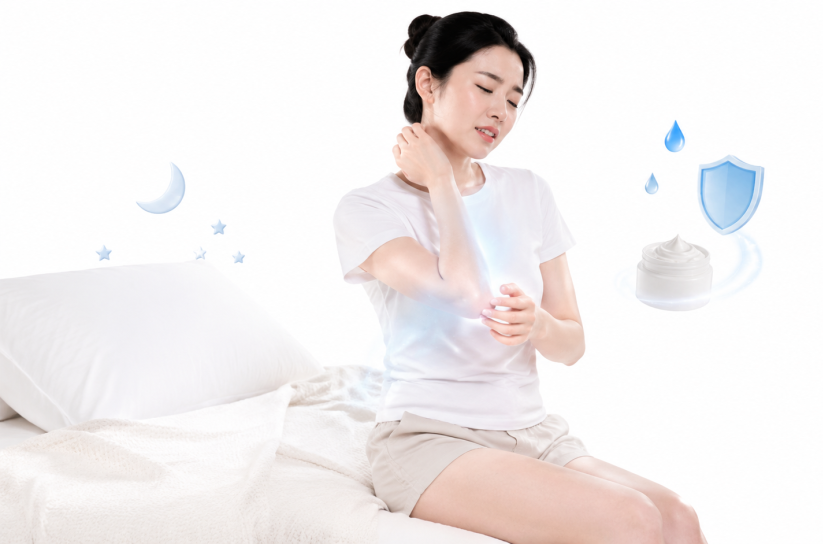
If you live with atopic dermatitis, eczema, or any kind of allergic skin condition, you've probably noticed a frustrating pattern: your skin feels manageable during the day, but the moment you lie down to sleep, the itching gets so bad you can't stop scratching.
You're not imagining it, and it's not a sign that your treatment isn't working. Your body goes through real physiological changes at night—shifts in hormones, body temperature, and skin function-that make itching easier to trigger and harder to ignore. This article breaks down exactly why nighttime itch happens and what's actually going on under your skin.
Your Skin Behaves Differently at Night Than During the Day
Daytime and nighttime skin aren't operating under the same conditions, even though it's the same body. During the day, your system stays in a more "alert" state to support activity. At night, your body shifts into repair and recovery mode, and that shift changes hormone levels, blood flow, and skin function all at once.
| Factor | Daytime | Nighttime |
| Anti-inflammatory hormone levels | Relatively high | Drop significantly |
| Skin surface temperature | Stays steady | Rises slightly |
| Skin hydration | Better maintained | Evaporates more easily |
| Brain's focus on itch signals | Distracted by other input | Sharply increased |
Because several of these changes happen simultaneously, the exact same skin condition can feel far itchier at 11 p.m. than it did at 2 p.m.
4 Reasons Eczema and Atopic Dermatitis Get Worse at Night
1. Cortisol Levels Drop, and Inflammation Control Weakens
Cortisol is the hormone responsible for keeping inflammation and immune overreaction in check. It naturally runs higher during the day and drops in the evening as part of your circadian rhythm.
That daytime cortisol acts like a brake on skin inflammation. Once it eases off at night, inflammation that was being partially suppressed can resurface-and itching along with it. This isn't a treatment failure; it's a predictable hormonal cycle that dermatology research has documented for years.
2. Skin Temperature Rises to Help You Fall Asleep
To fall asleep, your core body temperature needs to drop slightly. To achieve that, your body widens blood vessels near the skin's surface so heat can escape—a process called vasodilation.
The side effect: your skin surface actually feels warmer during this process. Warmer skin means more sensitive nerve endings, and histamine—the compound most closely linked to itching-becomes more active. Electric blankets, heavy comforters, or an overheated bedroom can make this effect noticeably worse.
3. Your Skin Loses Moisture Faster Overnight
Healthy skin relies on an intact barrier to keep water locked in. In people with eczema or atopic dermatitis, that barrier is often already compromised.
At night, transepidermal water loss (TEWL)—the rate at which moisture escapes through the skin-increases. Less moisture in the skin means more dryness, and dry skin reacts to even minor irritation with intense itching. This is exactly why applying moisturizer before bed is considered one of the single most important habits in eczema management.
| Healthy Skin Barrier | Compromised Skin Barrier |
| Locks in moisture | Loses moisture rapidly |
| Blocks outside irritants | Lets irritants penetrate easily |
| Feels soft and calm | Feels dry, tight, and itchy |
4. A Quiet Room Means Your Brain Focuses More on Itch Signals
During the day, your brain is processing constant input-conversations, screens, work, movement. That flood of stimulation naturally competes with and dulls itch signals coming from your skin.
At night, once the lights go off and the room goes quiet, there's far less competing input. Your brain becomes more attentive to every small signal from your skin, including itch. The itch intensity hasn't necessarily changed-your perception of it has.
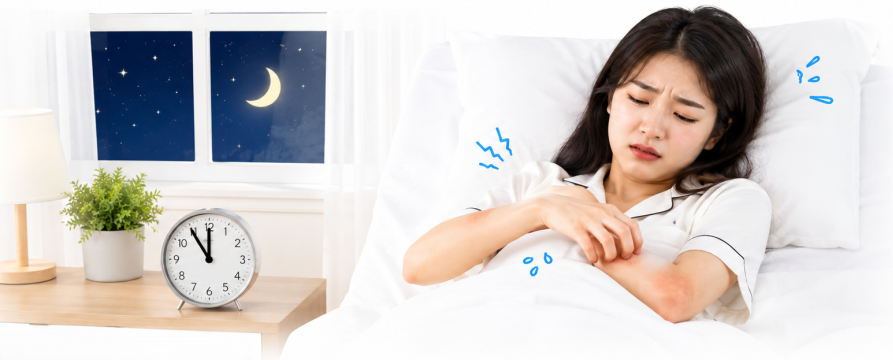
Why Scratching Makes It Worse (The Itch-Scratch Cycle)
Scratching feels like relief in the moment, but it actively damages the skin barrier and creates micro-tears that trigger more inflammation. That inflammation then produces more itching, which leads to more scratching.
| Step | What Happens |
| 1 | Itch sensation begins |
| 2 | You scratch |
| 3 | Skin barrier is damaged |
| 4 | Inflammation and dryness increase |
| 5 | Itching intensifies further |
This loop—itch, scratch, damage, worse itch—is one of the biggest obstacles to skin recovery, and breaking it is often more important than any single product.
Why Medication Alone Doesn't Always Stop Nighttime Itch
A common question in dermatology visits: "I'm using my prescribed cream and taking my medication-why do I still itch every night?"
This doesn't mean the treatment is wrong. Topical steroids reduce skin inflammation, and antihistamines calm itch and allergic response-but nighttime itching is also driven by circadian rhythm, temperature changes, dryness, and barrier function. Medication addresses inflammation directly, but it can't fully control the environmental and physiological factors happening around it. The best results usually come from combining medical treatment with consistent lifestyle habits.
| Treatment | Main Role | Still Needs to Be Managed |
| Topical steroids | Reduce inflammation | Dryness, skin heat |
| Antihistamines | Ease itching | Sleep environment, temperature |
| Moisturizers | Protect the skin barrier | Consistent daily use |
| Lifestyle habits | Reduce itch triggers | Long-term maintenance |
Practical Ways to Reduce Nighttime Itching
Keep your bedroom cool.
A warm room widens blood vessels and worsens itch. Aim for a room temperature around 65–68°F (18–20°C) with humidity between 40–60%. Avoid overheating with electric blankets or heavy, thick comforters.
Moisturize within 3 minutes of showering.
Skin starts losing surface moisture almost immediately after a shower. Pat skin dry gently, then apply a generous layer of moisturizer within a few minutes. Ceramide-based creams or ointments are particularly effective at reinforcing the skin barrier. A thin layer of petroleum jelly over dry patches before bed can also help seal in moisture.
Watch what you eat in the evening.
Spicy food, alcohol, and late-night snacking can raise skin temperature and worsen itch in some people. Eating a lighter dinner earlier in the evening also supports better sleep overall.
| Helpful Habits | Habits to Avoid |
| Light, early dinner | Late-night snacking |
| Adequate water intake | Excess alcohol |
| Regular meal timing | Very spicy food |
Soothe, don't scratch.
When the urge to scratch hits, try a chilled moisturizer or a cool (not ice-cold) compress instead. Wrap ice packs in cloth and limit contact time, since direct prolonged cold exposure can irritate skin further.
Talk to your doctor before changing medication on your own.
If nighttime itching remains severe, the issue may be dosing timing or treatment plan rather than the medication itself. A dermatologist can adjust your regimen based on your specific pattern of symptoms.
When to See a Dermatologist Again
Persistent nighttime itching isn't always just dry skin. Contact a dermatologist if you notice any of the following:
- Itching so severe it consistently prevents sleep
- Oozing, weeping, or pus from the skin
- Redness that keeps spreading
- Heat and pain alongside the itching
- No improvement after weeks of consistent moisturizing and medication
These signs can point to a bacterial infection or a different underlying skin condition that needs direct evaluation.

FAQ: Nighttime Itching
Does itching only at night always mean atopic dermatitis?
Not necessarily. Eczema, contact dermatitis, and hives (urticaria) can all cause nighttime-dominant itching. An accurate diagnosis from a dermatologist matters more than self-diagnosing based on timing alone.
Is it okay to use an electric blanket?
Using one on a low, moderate setting is generally fine, but overheating raises skin temperature and can intensify itching. Keep it as cool as comfortably possible.
Does petroleum jelly actually help?
It doesn't add moisture to the skin, but it forms a barrier that reduces water loss—which makes it genuinely useful as a nighttime seal-in step, especially over already-moisturized skin.
How can I stop scratching in my sleep?
Keep nails trimmed short, maintain consistent moisturizing, and control bedroom temperature and humidity. These steps reduce the itch triggers that lead to scratching in the first place.
Key Takeaways
| Topic | Summary |
| Why itching worsens at night | Circadian rhythm, temperature shifts, dryness, and barrier weakness combine |
| Why medication isn't always enough | Treatment addresses inflammation but not environmental triggers |
| Most important habits | Consistent moisturizing, a cool bedroom, proper humidity, steady routine |
| When to seek care | Oozing, spreading redness, pain, or no improvement over weeks |
Nighttime itching isn't a matter of willpower—it's the result of real biological changes your body goes through to prepare for sleep, combined with the state of your skin barrier. Atopic dermatitis and eczema are chronic conditions that respond best to steady, ongoing management rather than a quick fix.
Sticking with your prescribed treatment while also building consistent moisturizing and sleep-environment habits can meaningfully reduce nighttime flare-ups over time. If itching keeps getting worse or is seriously disrupting your sleep and daily life, don't just try to push through it—check back in with a dermatologist to reassess your treatment plan.


