Skin tags are harmless but common growths on the neck, armpits, and eyelids. Learn what causes them, how they differ from warts, and the safest removal and aftercare options.
What Exactly Is a Skin Tag?
You're in the shower, or catching your reflection in the mirror, and you notice a small, soft flap of skin hanging off your neck or tucked into your armpit. It wasn't there a year ago. It doesn't hurt. But it's definitely new, and now you can't stop touching it.
That growth almost certainly a skin tag, medically known as an acrochordon (or fibroepithelial polyp). It's one of the most common benign skin growths in adults, and according to dermatologists, roughly half of all adults will develop at least one during their lifetime, most often after age 40.
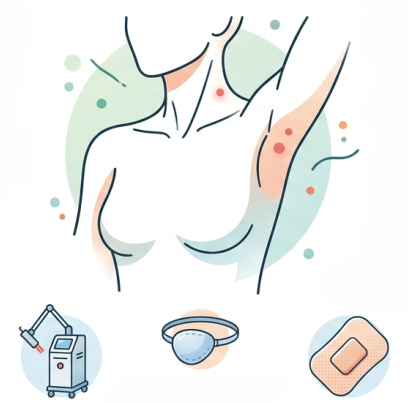
Skin tags are small, soft, flesh-colored (or slightly darker) growths that hang from a thin stalk of skin called a peduncle. They usually measure just a few millimeters, though larger ones can occasionally form. They tend to show up wherever skin repeatedly rubs against skin or fabric: the neck, armpits, eyelids, groin, and under the breasts.
The good news is that skin tags are not dangerous, not a type of cancer, and not contagious. They form because of localized overgrowth of skin cells and collagen fibers, not from a virus or from poor hygiene, a common misconception.
Skin Tag vs. Wart: What's the Real Difference?
Because skin tags and warts can both appear as small bumps, people often confuse the two, but they're fundamentally different conditions.
| Feature | Skin Tag (Acrochordon) | Wart (Verruca) |
| Cause | Skin cell overgrowth, friction, aging | Human papillomavirus (HPV) infection |
| Contagious? | No | Yes, can spread through direct contact |
| Texture | Soft, fleshy, hangs on a thin stalk | Rough, firm, often flat-topped |
| Pain/itching | Usually none, unless irritated | Can itch or feel tender, especially on the feet |
| Growth pattern | Grows slowly, stays isolated | Can spread to nearby skin or other people |
The single biggest distinction is the cause: skin tags come from your own skin tissue growing in a localized spot, while warts are a viral infection. That's why picking at a wart can spread it to other parts of your body, but a skin tag will never "spread" the way a wart can.
What Actually Causes Skin Tags?
Skin tags aren't caused by anything you did wrong. Research points to several overlapping factors:
Friction from Skin Folds and Clothing
Constant rubbing, whether from a necklace, a tight collar, or skin folding against skin, encourages localized cell overgrowth. This is why skin tags cluster so predictably on the neck, underarms, and groin.
Aging
As skin loses collagen and elasticity over time, the likelihood of developing skin tags rises. They're uncommon in children and become progressively more frequent from middle age onward.
Weight Gain and Obesity
Carrying extra weight increases the number and depth of skin folds, which means more friction. Obesity is also closely linked to insulin resistance, compounding the effect.
Hormonal Shifts, Including Pregnancy
Many people notice a sudden crop of new skin tags during pregnancy. Researchers believe surges in estrogen and progesterone, along with related growth factors, stimulate skin cell proliferation during this period.
Insulin Resistance and Metabolic Syndrome
This is the connection worth paying attention to. Multiple clinical studies have found that people with several skin tags are more likely to have type 2 diabetes, dyslipidemia, insulin resistance, and polycystic ovarian syndrome compared with the general population. One study of 113 patients with skin tags found notably higher rates of dyslipidemia, metabolic syndrome, obesity, hypertension, and insulin resistance than in people without them.
This doesn't mean a skin tag is a diagnosis on its own. But if you suddenly develop multiple new skin tags, especially before age 40, it may be worth mentioning to your doctor at your next physical, since it can be an early visual clue pointing toward blood sugar or cholesterol issues worth checking.
Do Skin Tags Go Away on Their Own?
Rarely. Most skin tags stay the same size indefinitely or grow slightly larger over time. Occasionally one will twist on its stalk and fall off on its own, but that process can be uncomfortable and isn't something to wait for or try to force.
Why You Should Never Remove a Skin Tag at Home
A quick search turns up plenty of DIY advice: tying a skin tag off with dental floss, dabbing it with apple cider vinegar, or simply snipping it off with nail clippers or scissors at home. Dermatologists consistently advise against all of these methods, and for good reason.
Cutting a skin tag with unsterilized tools risks introducing bacteria deep into the skin, which can lead to a spreading skin infection called cellulitis. Acidic home remedies like vinegar don't distinguish between the skin tag and the healthy skin around it, so they frequently cause chemical burns, permanent scarring, and dark spots that are far more noticeable than the original skin tag ever was.
There's also a diagnostic risk. Not every bump that looks like a skin tag actually is one. A dermatologist's job is partly to confirm what a growth is before removing it, ruling out other conditions that can resemble a simple skin tag.
Professional Removal Options
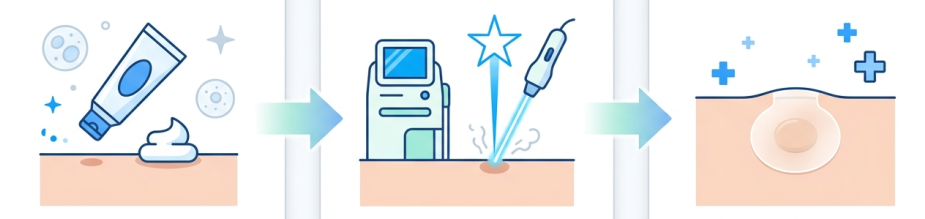
Once a dermatologist confirms the diagnosis, removal is quick and low-risk. The right method usually depends on the size and location of the tag.
| Method | How It Works | Best For | Recovery Notes |
| CO2 laser | Vaporizes the tissue with precision | Most common, minimal bleeding, fast healing | Keep the area covered and use sun protection |
| Erbium:YAG laser | Shaves tissue away in very fine layers | Lowering scar risk on visible areas | May stay pink longer; use a healing ointment |
| Cryotherapy (liquid nitrogen) | Freezes the tissue until it falls off | Smaller tags in select cases | Watch for blistering at the treated spot |
| Surgical excision | Physically cut away with sterile scissors or a scalpel | Larger or thicker tags | Requires proper wound care and sometimes stitches |
Most of these procedures take only a few minutes per tag and involve local anesthetic when needed. For very small skin tags, some clinicians skip anesthesia altogether since the discomfort is minimal.
Aftercare: How to Avoid Scarring and Dark Spots
What you do in the days after removal matters just as much as the procedure itself.
Keep the healing tape on.
Clinics typically apply a hydrocolloid dressing after laser removal. Even if it puffs up white with fluid underneath, leave it in place for two to three days unless your provider tells you otherwise; that fluid is actually helping the wound heal in a moist environment.
Limit water exposure.
Follow your provider's specific timeline, and if you do need to wash your face or shower, make sure the dressing is firmly sealed first.
Apply sunscreen diligently.
Freshly treated skin is highly prone to hyperpigmentation, dark spots that form when new skin is exposed to UV light. Dermatologists generally recommend consistent sun protection on the treated area for several weeks to months after the wound has closed.
Resist the urge to pick at scabs.
Let any scab fall off naturally. Picking dramatically raises the odds of permanent scarring.
Can You Prevent Skin Tags?
You can't fully prevent skin tags tied to genetics or aging, but a few habits can lower your risk or slow new ones from forming:
- Manage blood sugar. Cutting back on refined carbohydrates and sugar, and eating more fiber, can help address the insulin resistance associated with skin tag formation.
- Reduce friction. Choose soft, breathable fabrics over stiff or tight collars, and skip heavy necklaces that rub against the neck.
- Maintain a healthy weight. Since excess weight increases both skin folds and insulin resistance, regular physical activity does double duty here.
- Keep skin moisturized. Dry skin is more vulnerable to friction damage, so a fragrance-free moisturizer on the neck and underarms can help, along with daily sunscreen.
When to See a Dermatologist Right Away
Most skin tags are nothing to worry about, but book an appointment if you notice any of the following:
- Rapid growth in a short period
- The growth turning black or very dark
- Repeated bleeding
- Significant pain
- An irregular or asymmetric shape
- Any uncertainty about what the growth actually is
FAQ
Are skin tags a sign of cancer?
No. Skin tags are benign and have no malignant potential. That said, any growth that changes rapidly in size, color, or shape should be evaluated by a dermatologist to rule out other conditions.
Will skin tags come back after removal?
The exact tag that's removed won't grow back, but if your skin and lifestyle factors (friction, weight, hormones) stay the same, new skin tags can form nearby over time.
Is skin tag removal covered by insurance?
In most cases, no. Since removal is generally considered cosmetic, it's typically an out-of-pocket cost, and pricing varies by clinic, number of tags, and method used.
Do skin tags during pregnancy go away after birth?
Some shrink after delivery as hormone levels normalize, but many persist and require the same removal options as any other skin tag.
The Bottom Line
Skin tags are extremely common, harmless, and not something to panic over. But they're also not something to self-treat with kitchen remedies or sharp objects. If a growth bothers you, whether physically or just because you keep noticing it in the mirror, a quick visit to a dermatologist is the safest way to get an accurate diagnosis and a clean, low-scar removal.
This article is for general informational purposes only and is not a substitute for professional medical diagnosis or treatment. Please consult a licensed dermatologist for any specific concerns.


